

COMFORT is perhaps the first thing that most home builders consider, for unless a house is comfortable or “homey” it is no home at all-only a place to stay in as little as possible, not a place to live in, to grow old in. The matter of building a house that is comfortable is entirely a personal one, but its beauty, the aesthetic feature of it, is a matter of civic interest that concerns the whole community. The question of “our duty to our neighbor” comes tip then for consideration. If our neighbor builds a house that is dignified, simple in line, substantial in every way, with a well-kept yard and a profusion of blossoming plants all about, he has rendered us a great service. Not only has he enhanced the value of our property and that of everyone’s on the whole street, but he has given us something beautiful to look at and an inspiring ideal to live with.

Though our own home be the acme of good taste and comfort our joy in it would be greatly marred if whenever we looked out of our windows we saw the pretentious, ornate house of a near neighbor, with monstrously ugly hedges clipped to resemble dogs, or hens upon a nest, with purple flowers against a gabled and turreted and “gingerbread” red house. We are really helpless in the hands of our friends and neighbors more than we realize in the important matter of environment. So when the time, comes that our long desired home is actually to be built, when the “ways and means” problem has been solved, when the location has been decided upon, then comes our opportunity to add to the beauty of the village, town or city or country in which we. have decided to build our house. And because the house that we construct will contribute a weight of beauty or ugliness to the whole community, we should take all care that it adds to rather than detracts from the worth of the neighborhood.
Our home will help constitute the environment of our neighbors, for we cannot possibly build for ourselves alone.
It is always inspiring to see what other home builders have accomplished in the important matter of beautiful homes. Even though the new home eventually be utterly unlike any plan studied, yet the contemplation of good designs is a great help, and often furnishes unexpected suggestions.
No other style of inexpensive home has maintained its popularity so unfailingly as the bungalow. Home builders everywhere realize its universal adaptability, and are as much interested today in the development of the bungalow style as they were when it was first introduced. Other styles of inexpensive homes are constantly appearing, but rove of them have thus far succeeded in eclipsing or even equaling it.

The much advertised quality that makes the bungalow so readily adaptable to individuality is probably chiefly responsible for its continuous hold upon popularity, but whether or not this is true, the fact nevertheless remains that every home builder can be easily interested with photographs and descriptions of new examples of bungalow building.
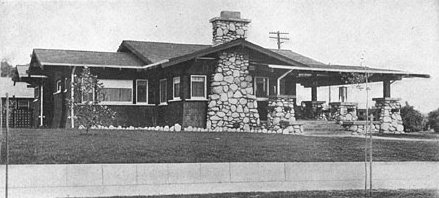
The photographs reproduced herewith illustrate a number of very attractive bungalows that have just been built in California. They are excellent specimens of the modern type of bungalow, representing the result of carefully studied development, and possessing the usual bungalow characteristics., All of them were designed and built by Edward E. Sweet, of Los Angeles.
Illustration No. I shows a nine-room bungalow built at a cost of $3,700. The floor plan contains living room, dining room, smoking room or den, breakfast room, kitchen and four bedrooms built around a court or patio. In the center of this attractive feature there is a small fish pond surrounded by ferns.

The remainder of the floor space of the patio is of concrete, and the comfortable seats of rustic design make it an excellent open-air lounging retreat. All of the rooms are reasonably large for a house of this kind, and a number of builtin features, such as bookcases, window seats, writing desk, buffet, as well as the fireplaces in the living room and smoking room, combine to make the interior most comfortable and convenient. The woodwork in the principal rooms is fumed oak and the floors are hardwood. The exterior is made attractive by a low flat asbestos roof of interesting line, two massive chimneys and other masonry of well-selected cobblestones and clinker brick and a spacious front porch that is floored with cement. The house is furnished with a basement and is heated by a furnace.
Photograph No. 2 illustrates a six-room bungalow that represents an expenditure of $3,6oo. The rooms are, living room, dining room, kitchen, two bedrooms and a sleeping porch. This is indeed an ideal little home, both in surroundings and workmanship. The charm of the exterior is due mainly to the interesting roof lines, including an ingenious suspension of the porch roof by chains. The siding is of cedar shingles, stained dark green, and the masonry is of clinker brick. This house is heated by a furnace, and besides this the living room contains a large fireplace of clinker brick. The picture of house No. 3 shows an eightroom bungalow that was built at a cost of $3,500. It contains living room, dining room, kitchen, maid’s room, three bedrooms and a sleeping porch. The foundation is built of cobblestones, and the massive chimney and half-length veranda pillars also furnish an excellent example of their use. The siding of the house is of cedar shakes spaced in an unusual manner, stained a rich brown, and the roof is shingled. In the living room is an excellent fireplace built of cobblestones. Photograph No. 4 shows a comparatively inexpensive eight-room bungalow, the cost of construction having been but $3,150. In this house there are living room, music room, dining room, breakfast room, kitchen and three bedrooms. The foundation is of cobblestones and clinker brick, and the siding and roof are of shingles. There are fireplaces in the living room and dining room.
No. 5 is a very attractive seven-room bungalow that cost but $3,100. The rooms are living room, dining room, breakfast room, kitchen and three bedrooms. This is an excellent little home for such a moderate outlay of money. The roof, which is of asbestos, has interesting lines, and the masonry, which is concrete, is of well-studied proportions. The woodwork is stained a dull green tone and this combined with the white pillars, chimrney and white roof, makes an effective color scheme. One of the admirable features of this bungalow is a rear pergola porch that is furnished for outdoor lounging. There are fireplaces in the living room and dining room, and builtin bookcases, and window seats aid in making the interior inviting and comfortable. The prices of the bungalows described in this article range from $3,100 to $3,700.

They are all substantially constructed, and, although they are located in California, where the winters are mild, they ought to be satisfactorily duplicated in any part of the United States for approximately the prices named here. Variations in the cost of materials in different localities will naturally produce some changes in the figures, but the fluctuations should not be great. The chief advantage to be had from the study of house plans is that of suggestion. Sometimes the mind needs the stimulus of a fine idea to enable its imaginative faculties to advance into new realms. Sometimes the presentation of a poor idea will incite the mind to a clever adjustment, and an entirely new and satisfactory plan may be evolved from the nucleus of the weak or inefficient one. An idea for an original and beautiful home may come to one and appear as a veritable inspiration until set down in the rigid lines that must be prepared for the builders to work from. Then its impossibilities and faulty proportions will be revealed in all their disappointing truthfulness. So it is always helpful to study what others have accomplished in the art of home building, and experiment for oneself, trying new or adapted plans until the design is carefully perfected. They must be set down on paper so that all their strength or weaknesses may be clearly seen, and where an enthusiastic imagination cannot so easily lead one into bogs of disappointment.