
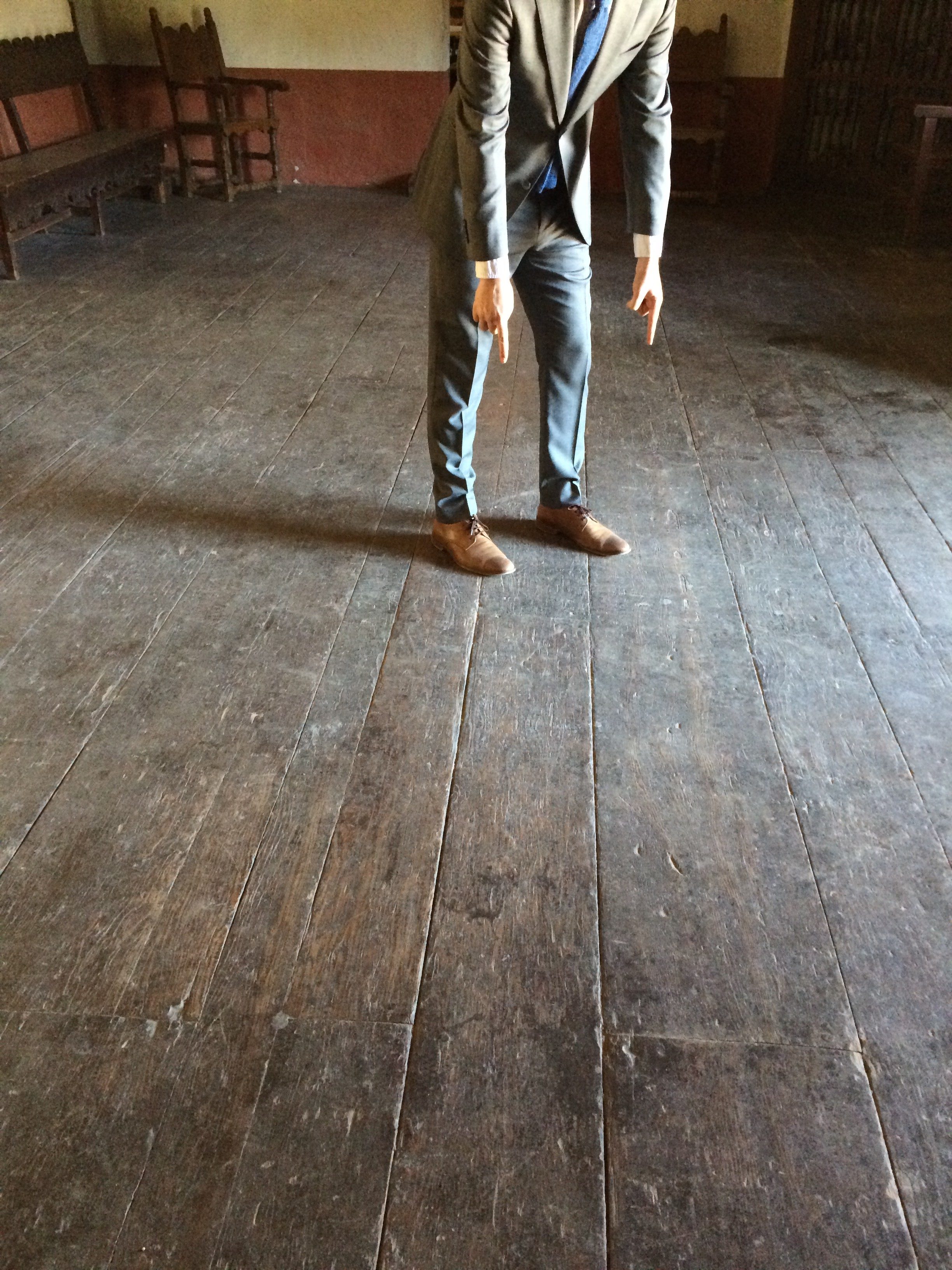
The wholly permissive world unleashes pedantry triumphant.
Whereas today historic preservation is often perceived as shackles, limiting the otherwise-boundless possibilities available to a builder or homeowner, we are nonetheless shackled by an unconscious set limits, circumscribing and narrowing the range of options, and increasing cost.
To illustrate, let’s look at the wood floor market.
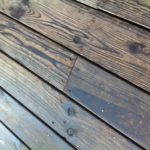
Ask your local floor salesman about softwood floor, and he will look at you like you have just broke the seventh seal. Why would you want softwood floors. No one wants softwood floors. They dent easily, look cheap, have knots, etc etc. He will tell you no one sells such a product. If you tell him you just want to nail common wood to the floor joists, prepare to be excoriated. No subfloor? Nails through the top of the wood? Think of the children! He might also leave you to wander the unknown “well, you can try it, but I have never seen it in all my 20 years of experience”. This highlights what I hope will be a recurring theme in this publication; the field of home restoration and historic preservation is far too vast to be encompassed by any one professional’s experience.
I am not against improvement.
Nailing in floors from the side was an innovation that prevented nails from showing, and from coming loose and injuring people. But like all improvements there are other factors. The first we are all familiar with as “the downside” of that improvement. Tongue and groove boards need extra milling, they are harder to replace, they must be set closely, which means more possibility of squeaking and other tolerance related issues. I’ve seen one too many engineered-wood tongue and groove floors form mountains when they got wet and expanded. The lack of tolerance left them nowhere to go but up.
The second factor is what might have been. We started with nails through the top of normal boards, we went on to nails through the side of tongue and groove, but are there other approaches that are better than both? Left to evolve along the pre-tongue-and-groove path, what would have happened? In Germany, sometimes thick floorboards are fastened to the floor joists, sometimes with screws right through the top, but set deep enough to accommodate some resurfacing. No laps, no grooves, just wood with large gaps between each board. Need to take one off for some reason (maybe to hide your manuscript from the Stasi)? No problem. Just unscrew it, remove it and re-fasten when you’re done.
Finally, and crucially, restoration in particular, and home improvement in general are highly-contingent undertakings. A seemingly discrete consideration is linked to every other consideration in many ways, but always by limited monetary resources. Money used on one project is money that cannot be used on another. Finding a basis to accept your out-of-the-norm wood floor may free up resources for other matters. This would then be an example of a highly synergistic home improvement approach. It takes less effort, costs less, is more historically accurate, and is unique. What’s more glassware and bones are less likely to shatter when making impact. It’s easier on your body, day to day, as well.
What I hope to communicate here, however, is that floors are largely about your attitude. If you want to declare yourself free of floor fuss, you will be in good company.
Let’s summarize:
- Floor Paint – Once completely common in the finest homes, it’s still common in the northeast, especially in old beach houses. Even patterns were painted on floors around the turn of the century.
- No subfloor – Until the teens, every home built in the history of the world had single layer wood floors.
- Softwood – This is a big one. Softwood is inexpensive, and beautiful. It is completely appropriate in any room, and was once common in every room except entertaining rooms. At some point salesmen convinced everyone they had to have hardwood, and now it’s hard to find references to softwood floors anywhere.
- Nails through the top – Again, literally every house since nails were invented had floors installed this way until the side nailing innovation took hold.
- Gaps – Decks have them, fine German homes have them, you can too. Lack of tolerance is costly.
- Different sized planks – Get some vintage wood, get it planed at a mill, and install it. Being okay with different widths opens up possibilities which brings down prices when you’re buying vintage wood.
- Different woods – Not for the faint of heart. Still looks and performs better than laminate.
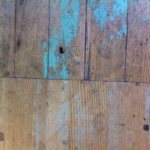
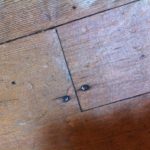
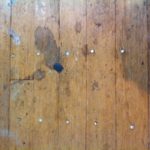
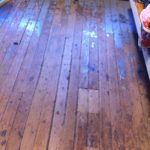

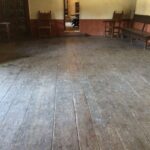
When we delve completely into historic possibilities, we find more, not less options, than are afforded us through the conventional routes too often oriented toward a narrowing set of imperatives and standards.