
On the occasion of Arroyo Historical’s opening up a full service window shop this month in San Marino, we here outline some of the unique challenges facing windows on the many historic homes of this community. Having repaired as many windows in this area as we have over the past 10 years, we have noticed some patterns. There are several factors that set the homes and history of San Marino apart from the surrounding communities. Most of San Marino’s historic building stock was built during the peak of the popularity of period revival architecture like Monterey Revival, Spanish Colonial Revival, Mediterranean Revival, French Revival, Tudor Revival and Storybook. The windows on these homes were built to be weatherproof and in some cases “storm-proof”. This is fortunate since, by design, these houses lack the deep eaves of craftsman homes, for example. What’s more, they are clad in stucco, rather than wood, and thus have issues peculiar to that modality. But there are much more particular factors unique to San Marino, which we will get to.
In the name of holistic rigor, it’s worth giving a brief summary of how stucco homes handle moisture.
“Flashing” is a very mystified and fussed-over category in construction, but anyone who knows why you don’t tuck in a raincoat knows the essence of flashing. It refers to any techniques which direct water from the building envelope back into the environment. By design, water that inevitably makes it through the porous stucco is caught by a layer of felt and carried downward to a horizontal length of 2-inch thick redwood known as a “mud sill”, where the felt is nailed in. If you see evidence of water leaking down the inside of your foundation wall in the form of white mineral deposits (or efflorescence), this is by design. The water from the felt “weeps” onto the mud sill and onto the foundation wall, saturating it. If your crawlspace is well vented as it was designed to be, the moisture evaporates out of the foundation wall back into the environment, and the whole system dries out in preparation for the next storm.
Windows and doors are holes in this otherwise seamless rain coat, so care must be taken to direct the water around these apertures without compromising the overall envelope. But what about rain that comes in at an angle and pelts the window directly? Older windows are made of extremely dense, rot-resistant wood that is not grown anymore. Just like the homes they are found in, these windows are noted by engineers for their “hydric capacity” which refers to the amount of moisture they can take on without failing in any way. Nonetheless, these homes were originally designed to minimize the need to rely on this last defense. Looking at historic photographs of homes in this area, you will notice many more cloth awnings. (Not promotional or architectural photos, but the harder-to-find everyday, family photos) This holds generally for all styles, even craftsman. But doubly so for houses without eaves.
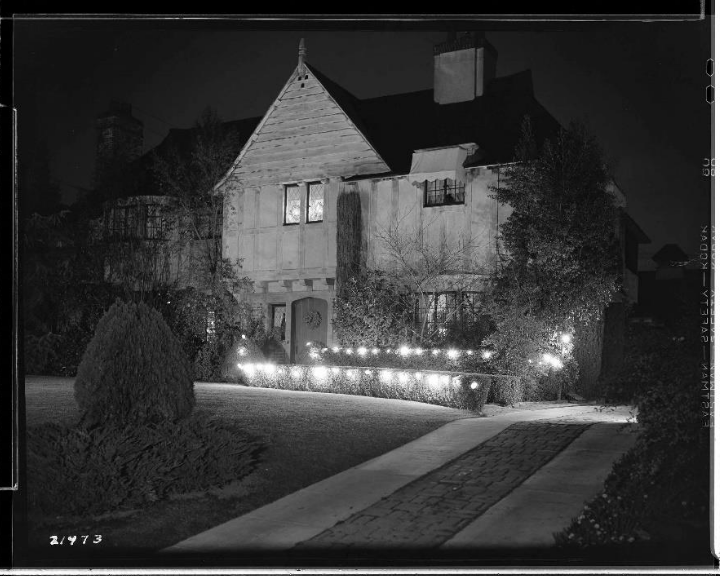
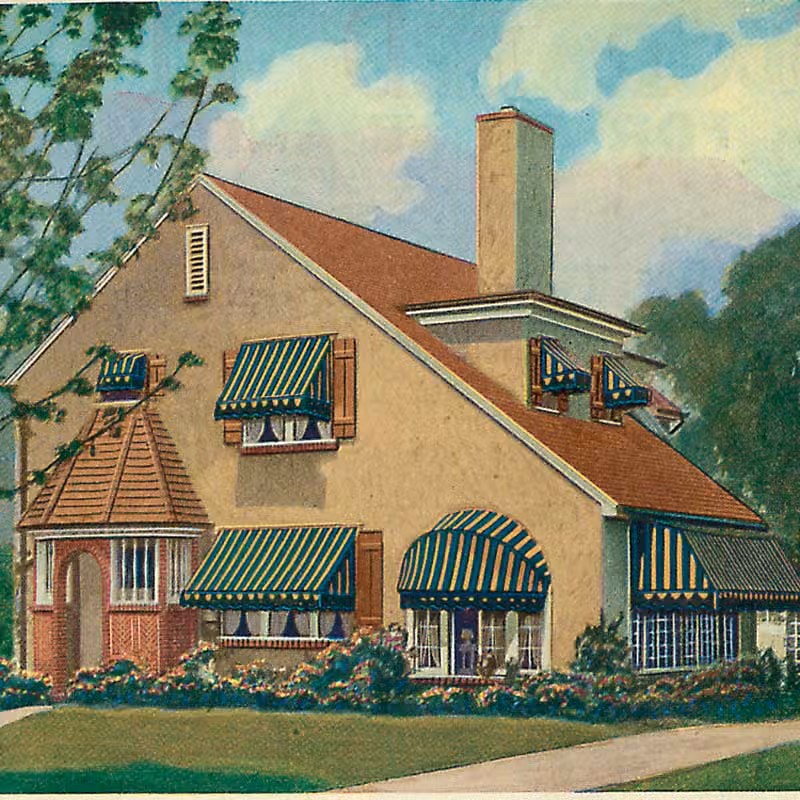
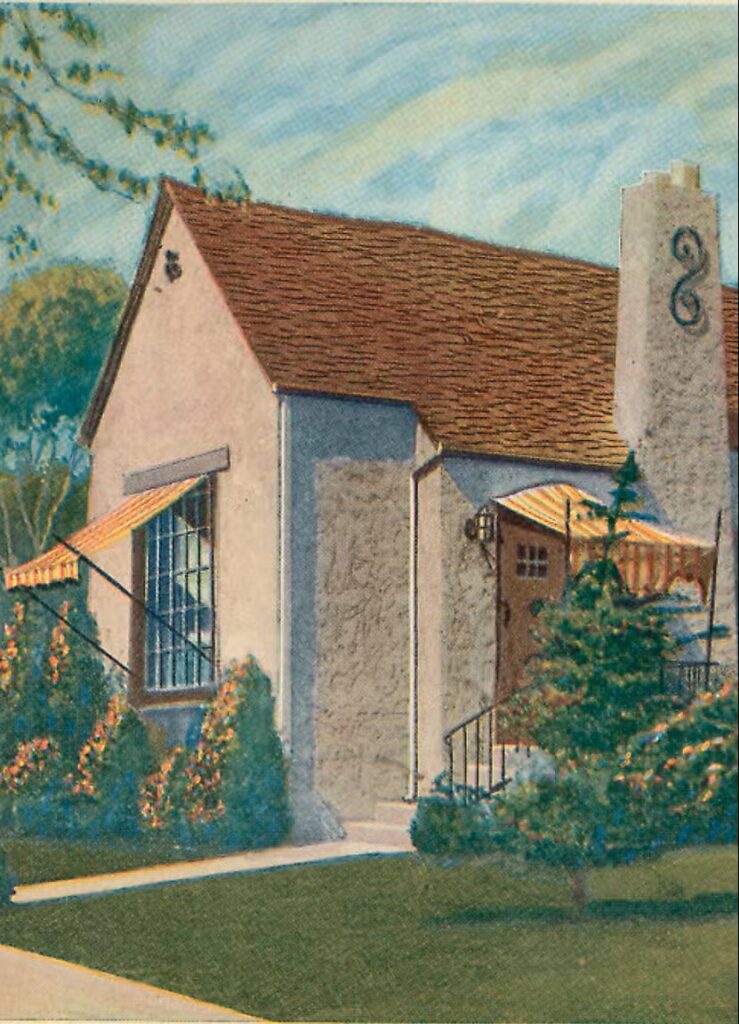
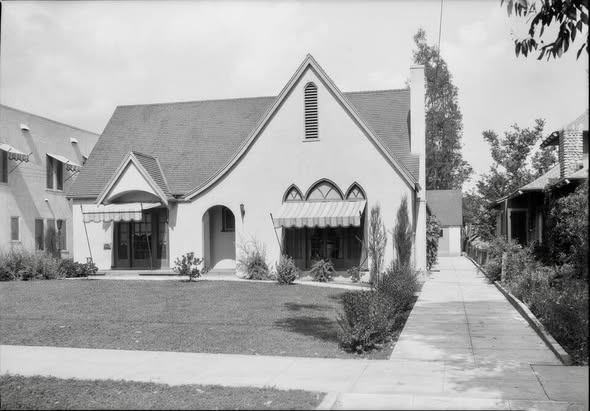
The change came with indoor air conditioning. Like trees, awnings, which are primarily prized for shade, were suddenly thought to be needless obstructions of the view, and they were removed in great numbers.
Nobody realized that awnings also protect windows from water.
If your home had a view, you were even more likely to eliminate your awnings. Homeowners who could afford to be an early adopters of air conditioning removed their awnings first and in highest numbers. Those who had more picturesque views to gain doubly so. Now San Marino isn’t the only community that could afford early air conditioning, nor were they the only community with views they wanted to maximize. Hancock Park has just as many stucco homes without eaves and just as many affluent owners, but they had the ocean breeze. San Marino was situated in an area historically prized for an abundance of natural fresh water access from the nearby canyons, but it is famously far enough inland to be out of the path of the ocean breeze.
In summary, these four features were unique to San Marino not individually, but in the sheer magnitude of their combination
- Concentration homes without eaves
- Concentrated early adoption of central air
- Picturesque views
- Inland situs and concomitant heat
- concentration of irreplaceable monument-grade historic wood windows that are worth repairing
These windows are mostly made of the best of the best material available at the time, and thus, even with all the extra abuse they have endured due to the post-war awning apocalypse, they are eminently repairable without as much fuss as would be the case for windows of lesser quality. Clients call us with the following complaints, all of which are completely fixable.
- Windows make noise
- Drafty windows with gaps
- Windows open and close roughly
- Windows rattle
- Windows do not open
- Window sagging
- Window not working
So what about the awnings? We recommend putting them back in cases where you can stomach it. In this climate, no r-value can compensate for the loss of shade, and besides, the service life of double pane gas filled, or vacuum inter-layer glass units is a fraction that of original windows. Numerous studies from the USDA, DOI and agencies in Europe have demonstrated that the cost of replacement is never recouped by lower bills, and further, much-less the overall carbon footprint. But if you are after more insulation and sound-proofing, plain old laminate glass achieves 90% of the performance of gas or vacuum inter-layer double glazing, all while appearing like traditional single pane glass.
If you absolutely cannot have awnings, there are alternatives. In addition to the weatherproofing techniques like spring bronze and interlocking metal weatherstripping, we alone offer tried and true stormproofing techniques only found on the best homes from 1910 through the 1920s. In cases where new windows are needed, we can make replicas of the originals.
Estimates cheerfully given. Call Angelo at (626) 989-1285