
Here at Arroyo Historical, we pride ourselves on period awareness. We are obsessed with finding not a compromise, but an intersection of frugality, historic accuracy, quality, safety and livability. As a starting point, we reject that these imperatives are in necessarily in conflict. Our pursuit of this ideal brings us into contact with the dark corners of the internet, and even (gasp) print and (double gasp) actual old buildings. We have found that, for example, common period interiors were rarely photographed. One has to look at old ads to get pictures of common materials one might find in a kitchen. Looking at restoration blogs, magazines and local homes, you get an idea of what turn of the century craftsman homes were like. 3-on-1 windows, a red door, Stickley everything on the inside, a colonnade and pendant lights. These ideas are reinforced by visits to places like the Gamble House. But the Gamble House was literally one of the first homes in the area to have electricity, and they were extremely affluent. The mimicry of only the homes of the wealthy is not in keeping with the spirit of historic restoration. In Los Angeles, those hanging pendant lights would not have been possible in most homes until electricity was installed after 1916.

Most people could not afford to spend the money or time to pursue gesamptkunstwerk of craftsman design. Furthermore, many who tried were just as likely to have their non-pedigree creations discarded by future owners. Kitchens mostly remained utilitarian affairs well into the teens. What’s more every area except for architecture was about 20 years late to the craftsman aesthetic party. So imagine walking into a craftsman home in 1906. Gas or oil lamps hanging from the ceiling, oil lanterns in bedrooms, a baroque or victorian-styled piano or organ, a clawfoot tub and a grotesque wood burning stove in the kitchen. Ladder-back chairs, a hand-me-down table, lace curtains on invisible brass utilitarian rods. The craftsman aesthetic was spreading, but people were still clinging to their old nicknacks and heirloom furniture, pictures and, yes, hair sculptures. 
But we find some truly unexpected and even outlandish details right in the pages of the ultimate arts and crafts standard-bearer; Gustav stickley’s magazine The Craftsman.
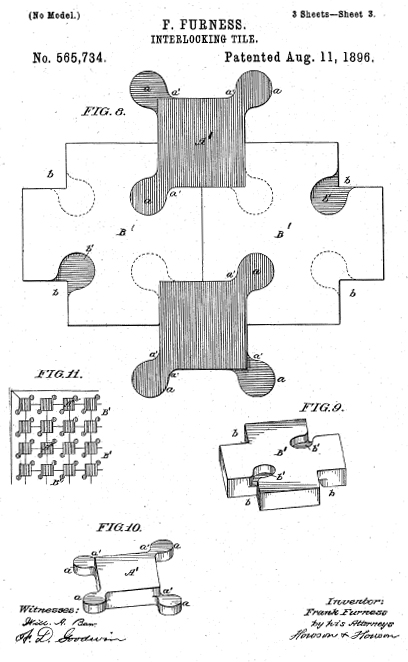
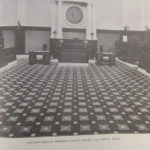
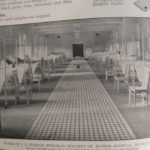
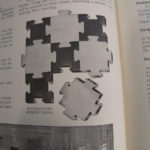
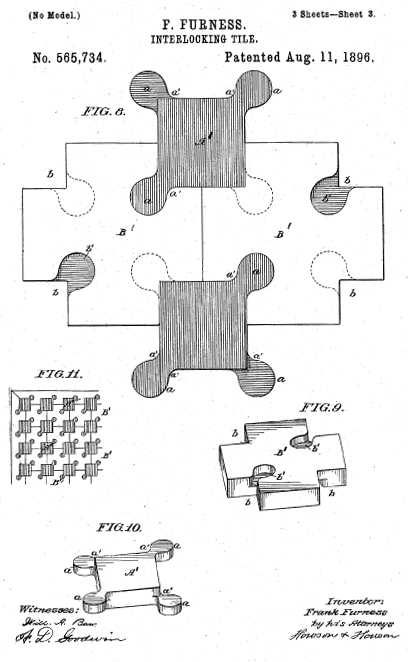
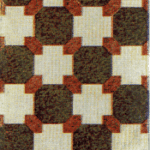
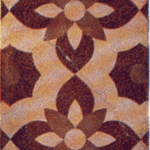
Most craftsman home restorers go straight to wood for the kitchen and hallways, but linoleum was once common. It may surprise some readers to know linoleum began replacing oil cloth floor in the 1870s. But fewer readers still have heard of rubber flooring in the house, much less rubber floors as a card-carrying arts and crafts material. An early issue features none other than Craftsman darling Harvey Ellis advising bachelors to install interlocking rubber floor tiles and to run them up the wall to “form a wainscot”. These colorful tiles, patented by Victorian genius Frank Furness in 1894, are virtually non existent today.
In another article, white roofs are featured–another non-existent detail in otherwise accurate neighborhoods like Bungalow Heaven, Pasadena and South Pasadena. The material of these white roofs is asbestos, which places absolutely authentic reproduction on this count just out of reach (well, legally, anyway). The material is probably also no longer readily available. The question of what to do in such a situation can be pondered to no end, or it can be ignored. If the point is to give the community some connection to it’s past, what does it matter if the white roof is not made of asbestos? Well, you might find that a non-asbestos roof does not stay white.
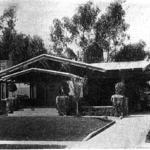
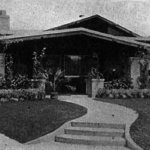
We like to think of historical details as looks to be mimicked in order to fool the eye, when in reality there is a function to these materials, and a great deal more to learn from them than how they appear. The looks-based approach is pursued ostensibly to cut costs, but it can just as easily arise out of laziness or defeatism. I call this production periodism. But Jim Baily of the National Parks Service has a better term: Disneyfication. When you walk down mainstreet in Disneyland, you find cliche’s of turn-of-the-century details. This is perhaps suitable on a studio lot, but not in your home (unless you are into that sort of thing). Not only does it degrade the home, it carries the additional hazard of restoration creep. When production periodism is adopted in parts of the restoration industry, it can work its way into the habits of professionals, eroding craft, and finally manifesting as an overall signal-to-noise degradation of historic transmission. Add to this the prevalence of old house restoration TV shows, and you have the makings of cultural disaster. These shows are oriented toward selling products and they cater to a crowd who puts their transient tastes above the integrity of the home. Original plaster walls sagging a bit? Rip them out and put drywall! Personally, I am a fan of what one might call “the Colonial Williamsburg approach”. It seeks to not only restore looks of buildings, but also the crafts which built them. Don’t write off absolute authenticity as an extravagance until you’ve actually researched it. You just might find that the difference in cost is negligible or inverse, and that the advantages far outweigh the thought-to-be pragmatic approach. The field of options outside the norm is far and wide! Look and you will find options. Don’t rush it.
Once you dispense with the childish hope that changes in materials and practice over time are necessarily oriented toward quality, it becomes clear that historic loss is often loss of other desirable qualities.
The ugliest or least accurate solution is not automatically the most affordable, the most pragmatic or the most practical. “Zero maintenance” usually means “replace when worn”. And as this post illustrates, here is a whole category of lost options which form a huge catalog of additional options available to the period-minded restorer. Sometimes, as in the case of interlocking rubber tiles, forgotten period details re-arise as an affordable, utilitarian products. Research and creativity are a better path to balancing practicality and accuracy. The frugal purist has no other options.